EDUCATIONAL ARTICLE
Why Your Risk Per Trade Needs a Rule
Define acceptable loss before entry so position size follows the plan instead of emotion.
TRADINGEDX
Why Your Risk Per Trade Needs a Rule
Most traders carefully research entries, study charts, and debate indicators. Far fewer decide in advance exactly how much of their capital they are willing to lose on the next trade. Without that decision, every position becomes an open-ended experiment. A single oversized loss can erase weeks or months of careful work, damage confidence, and trigger a cascade of emotional decisions that compound the damage.
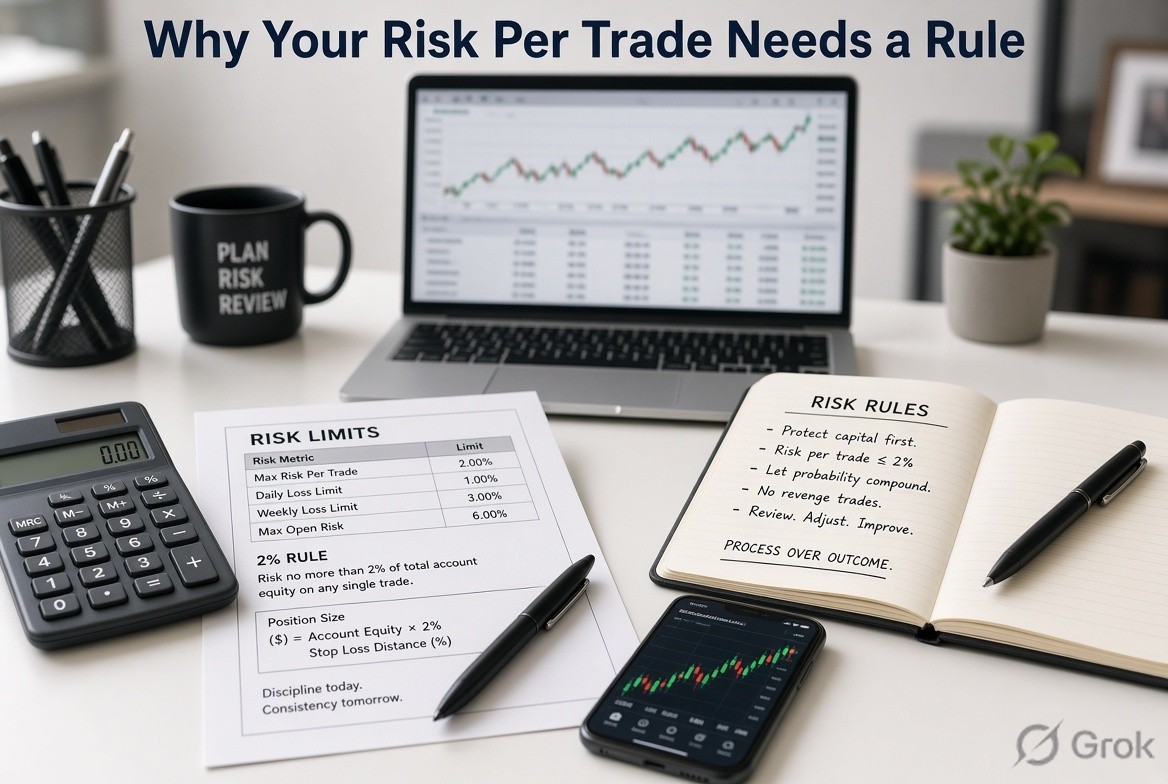
A fixed rule for risk per trade exists for one primary reason: to keep any individual loss small enough that the trader remains solvent, clear-headed, and able to continue. The most widely tested version of this rule limits risk on any single trade to a small fraction of current account equity—commonly 2 percent. The exact percentage is less important than the existence of a hard, pre-committed limit that is applied without exception.
The Problem of Unruled Risk
When risk is decided in the moment, several predictable errors appear:
Position size is chosen by how “confident” the trader feels about the setup.
Stops are placed where they feel comfortable rather than where the trade idea is invalidated.
After a series of wins, size increases. After a series of losses, size often increases further in an attempt to recover quickly.
Correlation risk is ignored; several positions that look independent can move together and create a much larger drawdown than expected.
In each case the decision about risk is emotional rather than mathematical. The market does not care about the trader’s feelings. It only responds to the size of the exposure.
What the Rule Actually Controls
A proper risk-per-trade rule does not limit the size of the position in isolation. It limits the dollar (or rupee) amount that will be lost if the protective stop is hit. That amount is calculated before entry:
Maximum risk amount = Current account equity × Chosen percentage (for example 0.02)
Position size is then derived from that maximum risk amount divided by the distance between the entry price and the stop.
The stop is placed first, according to market structure. The size is adjusted afterward so that the predetermined risk is not exceeded. This sequence is essential. Reversing it—choosing a large position and then stretching the stop to make the risk percentage look acceptable—defeats the purpose of the rule.
Why a Fixed Percentage Works
Three practical advantages make a fixed fractional rule superior to discretionary risk decisions.
Mathematical survival.
A series of losses is inevitable. If each loss is limited to 2 percent of equity, a string of ten consecutive losses reduces the account by roughly 18 percent (because the percentage is applied to a declining equity base). Painful, but recoverable. Without a rule, the same sequence of losing trades can easily reduce the account by 40, 50, or 100 percent.
Psychological stability.
When the maximum loss is known and accepted in advance, the emotional charge of the trade decreases. The trader no longer needs to “hope” the position works because the cost of being wrong has already been defined as a normal business expense. This clarity reduces the urge to move stops, add to losers, or exit winners prematurely.
Consistency of measurement.
Every trade can be evaluated in the same unit—one “R,” where R equals the predetermined risk. Win rate, average reward-to-risk, and expectancy become meaningful statistics rather than vague impressions. Improvement becomes measurable.
The Supporting Framework
A single-trade risk limit is necessary but not sufficient. Two additional controls complete the defensive structure:
A monthly or equity-curve circuit breaker (often around 6 percent) that suspends new trading when cumulative losses reach a predefined threshold.
A quality filter that restricts trading to higher-grade setups only. Taking only the clearest opportunities reduces the number of times the 2 percent risk is exposed in the first place.
Together these elements form a coherent risk system: limit the damage of any one trade, limit the damage of any one period, and limit the number of marginal trades that are allowed to occur.
Common Ways the Rule Is Broken
Calculating risk on the original account size rather than current equity.
Ignoring open risk from existing positions when adding a new one.
Using a mental stop instead of a working stop, then failing to honor it.
Increasing the percentage after a winning streak because “the system is working.”
Treating the rule as a guideline rather than a hard constraint.
Each violation reintroduces the original problem: risk decisions made under the influence of recent results or current emotions.
Implementing the Rule in Practice
Decide the maximum percentage once and write it down.
Before every trade, calculate the exact risk amount based on current equity.
Place the stop at the structural level that invalidates the idea.
Compute the largest position size that keeps the loss inside the risk amount if the stop is hit.
Check that the new risk, added to existing open risk, remains inside the broader portfolio limit.
Only then enter the trade.
The sequence takes less than a minute once it becomes habitual. That minute is the difference between controlled exposure and uncontrolled exposure.
Closing Thought
A risk-per-trade rule is not a prediction tool and it does not improve the accuracy of any single entry. Its value is more fundamental. It ensures that the trader is still present—financially and emotionally—when the inevitable losing trades occur and when the eventual winning trades appear. Markets reward those who can stay in the game long enough for their edge to express itself. An unruled approach to risk repeatedly removes participants from the game.
Decide the maximum loss you will accept on any one idea. Calculate it from current equity. Enforce it without negotiation. In that single discipline lies the practical foundation of longevity in trading. Everything else—analysis, timing, psychology—rests on the simple decision to keep each individual risk small enough that it cannot end the enterprise.
Educational content only. Not investment advice. Past performance is not indicative of future results. Use delayed or historical data concepts.
Keep your process close.
Continue learning
A practical framework for defining your market, setup, risk, and review process before taking a trade.
Learn to identify trends, ranges, and meaningful levels with a clean, repeatable chart-reading process.
Use simple position-sizing logic to define risk first and keep a single outcome from steering your account.
COMMUNITY DISCUSSION
Share your takeaways and join the conversation around this lesson.